
How to Price Web Design Services as an Agency
The Challenge of Scaling: How to Price Web Design Services as an Agency
For many US-based digital agencies, the most difficult conversation isn't about creative direction or user experience—it’s about the invoice. Determining how to price web design US agency services requires a delicate balance between remaining competitive in a crowded market and maintaining the healthy margins necessary to scale your operations. If you price too low, you risk being perceived as a commodity; price too high without the right positioning, and you lose out to agile boutique firms.
The American market is unique because of its high overhead costs and the client’s expectation for high-touch communication. When you are managing a team in New York, Austin, or San Francisco, your pricing must reflect the value of your strategic oversight, not just the hours spent in Figma or Adobe XD. To thrive, your agency needs a repeatable pricing formula that accounts for creative talent, project management, and the inevitable scope creep that comes with high-end web design projects.
In this guide, we will break down the most effective pricing models used by successful American agencies today. Whether you are a startup agency or an established firm looking to outsource through white-label partnerships, understanding these financial foundations is the key to sustainable growth.
Evaluating the Three Primary Pricing Models
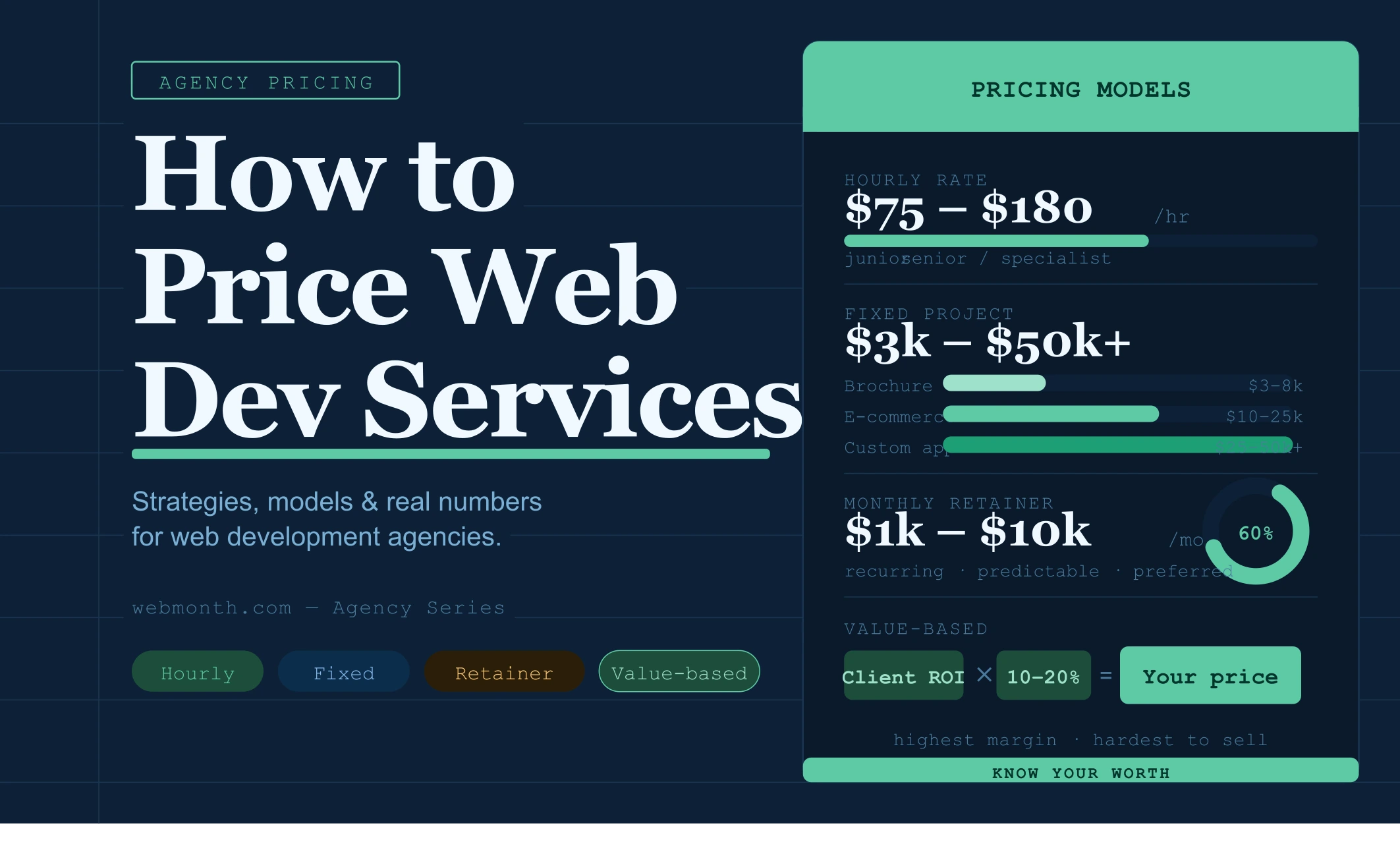
When deciding how to price web design US agency projects, most firms fall into one of three categories: Hourly, Flat-Fee (Project-Based), or Value-Based pricing. Hourly billing is the most transparent but often punishes your team for being efficient. If your senior designer can create a stunning homepage in three hours that takes a junior designer ten, you shouldn't be earning less for the superior, faster work. This is why many US agencies are moving away from the "clock-in" mentality.
Flat-fee pricing is the gold standard for mid-market agencies. It provides the client with budget certainty and allows your agency to build in a profit buffer. However, the risk here is underestimation. To make flat-fee pricing work, you must have a rock-solid Discovery Phase. Without it, a "simple 5-page site" can quickly spiral into a 20-page headache that eats your entire margin. Many successful US agencies add a 15-20% "contingency fee" to their internal estimates to cover these unknowns.
Value-based pricing is the "holy grail" of agency finance. Instead of charging for the work, you charge for the impact. If a redesign for an e-commerce brand is expected to increase their annual revenue by $1 million, a $50,000 price tag is a bargain, even if the design work only takes your team forty hours. This model requires deep industry expertise and the ability to sell a business outcome rather than a digital asset.
Benchmarks for the US Web Design Market
To remain competitive, you must understand the current market rates across the United States. While a freelancer might charge $2,000 for a website, an established agency rarely touches a project for less than $5,000 to $10,000. For mid-sized agencies targeting B2B clients, the sweet spot for a custom, high-performance web design project typically ranges from $15,000 to $50,000. Understanding these benchmarks helps you position your price web design US agency strategy against the right competitors.
Geography still plays a role, though less so in the age of remote work. An agency based in a high-cost-of-living area like Los Angeles or Chicago often has higher base rates to cover physical studio space and competitive local salaries. However, even if your team is remote, your pricing should reflect the "US Agency Standard"—which includes professional project management, legal protections, and American English-standard copywriting and UI/UX design. Clients pay a premium for the security and ease of working with a domestic partner.
Don't forget to account for the "Tier System" of web design. A basic brochure site for a local service business is priced very differently than a high-conversion lead generation site for a national SaaS company. By categorizing your services into "Essentials," "Professional," and "Enterprise" tiers, you can anchor your prices and make your mid-tier option look like the most logical choice for the average American business owner.
The Hidden Costs of Web Design Projects
One of the biggest mistakes agency owners make when they price web design US agency packages is forgetting the "soft costs." Web design is not just about the final layout; it is about the dozen meetings, the three rounds of revisions, and the hours spent chasing the client for brand assets. In the US market, client management can easily take up 25-30% of the total project time. If you don't price this in, your hourly realization rate will plummet.
Software and overhead are other factors that eat into margins. Subscriptions for Figma, Adobe Creative Cloud, stock photo libraries, and prototyping tools like InVision add up. Furthermore, the cost of specialized US-based talent is rising. To maintain a 50% gross margin, your pricing must be at least double the direct labor cost of the designers working on the project. This ensures you have enough left over to cover your rent, marketing, and business development efforts.
Finally, consider the cost of quality assurance (QA). A high-end US agency cannot afford to deliver a design that looks broken on a mobile device or a specific browser. Professional QA testing is a mandatory step in the design process. Whether you do this in-house or through a white-label partner, the time spent ensuring the design is pixel-perfect across all viewports must be reflected in your final quote.
Using White-Label Partners to Protect Your Margins
Many US agencies struggle to stay profitable because their internal overhead is too high. This is where white-labeling becomes a strategic financial tool. When you partner with a specialist like Web Month, you gain access to high-quality design talent at a fixed, predictable cost. This allows you to price web design US agency services with total confidence, knowing exactly what your fulfillment cost will be before you even send the proposal to the client.
By outsourcing the heavy lifting of the design phase, your core team can focus on high-value activities like strategy, client relationships, and upselling. For example, if your white-label partner charges you $3,000 for a comprehensive UI/UX design, and you sell that design to your client for $9,000, you have secured a $6,000 gross profit while only spending a few hours on project oversight. This is the most efficient way to scale an agency without the HR headaches of hiring full-time staff in expensive US markets.
White-labeling also allows you to offer a wider range of design styles. Instead of being limited to the aesthetic of your one in-house designer, you can leverage a larger pool of talent to match the specific brand needs of your client. This versatility allows you to take on more diverse projects and increase your agency's total revenue without increasing your fixed monthly expenses.
Upselling and Recurring Design Revenue
The most successful agencies don't just stop at the initial launch. To maximize the lifetime value of a client, you should incorporate recurring revenue into your price web design US agency model. Design is never truly "finished." Brands evolve, new products are launched, and conversion rates can always be optimized. Offering "Design Retainers" or "Growth-Driven Design" packages ensures your agency has a steady stream of income long after the initial site goes live.
Consider offering a monthly "Creative Refresh" package where you update landing pages, create new social media graphics, or perform A/B testing on design elements. In the US, many small to mid-sized businesses don't have an in-house designer and are happy to pay a monthly fee of $1,500 to $3,000 to have an agency on standby. This shifts your relationship from a one-time vendor to a long-term strategic partner.
Additionally, you can upsell specialized design services like brand identity packages, pitch deck design, or custom iconography. By bundling these with the initial web design project, you increase the total contract value. American clients often prefer a "one-stop-shop" experience; if they trust you with their website, they would rather pay you more to handle their entire visual identity than find another vendor.
Conclusion: Mastering Your Agency’s Profitability
Pricing is more than just a number; it is a reflection of your agency’s positioning, expertise, and the value you provide to the American business landscape. To effectively price web design US agency services, you must move beyond simple hourly estimates and embrace a model that accounts for overhead, client management, and the high standards of the US market. By balancing competitive benchmarks with internal efficiency, you create a sustainable path to growth.
Remember that your goal is to build a profitable, scalable business. Whether you choose a flat-fee model for its predictability or a value-based model for its high upside, the key is consistency. Don't be afraid to raise your prices as your portfolio grows and your processes become more refined. High-quality clients in the US are willing to pay for quality, reliability, and a design that actually moves the needle for their business.
If you find that your internal costs are preventing you from hitting your profit goals, consider how a white-label design partner can help. By streamlining your fulfillment and fixing your production costs, you can focus on what you do best: growing your agency and serving your clients. With the right pricing strategy and the right partners, there is no limit to how far your agency can go.